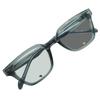
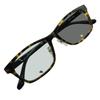
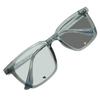
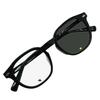
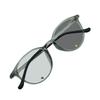
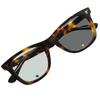
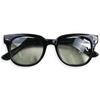
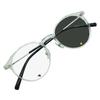
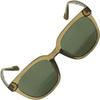
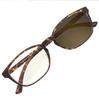
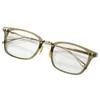
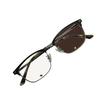
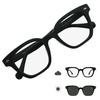
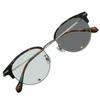
Photochromic lenses change color in response to ultraviolet and visible light. These lenses are almost colorless indoors, but change color in response to sunlight when you go outside. Regardless of the degree of color change, they block almost 100% of ultraviolet rays. This visible light photochromic lens type reacts not only to ultraviolet light but also to visible light, so it will color even inside a car with UV protection. Furthermore, considering eye health, it blocks almost all ultraviolet rays, which are said to be one of the causes of cataracts. It also reduces eye strain caused by the glare of the sun. These are stylish and eye-health-conscious lenses. These are fashionable and cool Wellington-style classic design color-changing sunglasses. The thick acetate frame gives it a substantial and sturdy feel. The Asian fit nose pads make it easy to fit Japanese faces.
Inside a car, the color is moderate (approximately 40-50% tint) *It will not become completely dark. Car windshields have UV protection. Conventional photochromic lenses change color in response to ultraviolet light, so their effect cannot be expected inside a car. HOYA Senscity Dark lenses react to visible light, so they can be used inside a car. Outdoors, they are dark (80-90% density). While regular photochromic lenses are easily affected by temperature changes and do not darken as easily at high temperatures, visible light photochromic lenses have a much higher color density compared to regular photochromic lenses, and perform well even in high-temperature environments.
A lens cleaning cloth and folding case are included as a service. Lens size: Width approx. 52mm, Height approx. 39mm, Bridge width approx. 22mm, Temple length approx. 150mm, Overall width 145mm, Frame weight 23.5g. The frame is made overseas, but assembly is done domestically. Temple size indicated: 53□19-148
Color characteristics: Type of light it reacts to: It reacts not only to ultraviolet light, but also to visible light. Therefore, the lens color changes even inside a car with UV protection. Color Development Speed: After reacting to ultraviolet light, the color darkens within approximately 90 seconds, quickly becoming like sunglasses. Fading Speed: The fading speed has also been improved, and the color fades about twice as fast as conventional lenses. Factors Affecting Density: Amount of UV Light: The more UV light there is, the darker the color tends to develop. Temperature: The lower the temperature, the darker the color will be, and fading may also take longer. For example, the color tends to darken more easily in winter than in summer. Density Inside a Car: Inside a car, the lenses will be tinted to a moderate level depending on the lighting conditions, but will not reach full density. This is also affected by the material of the windshield, whether the windows are open or closed, and the position of the seat.
![[OTC.web] 9618HKCH Photochromic Sunglasses that change color even inside a car, UV protection, darkening tint, men's Wellington style, classic,](https://img.joomcdn.net/47b1cec0cb340bbe1091aa9166574560c5e6fba2_1024_1024.jpeg)
![[OTC.web] 9618HKCH Photochromic Sunglasses that change color even inside a car, UV protection, darkening tint, men's Wellington style, classic,](https://img.joomcdn.net/5f0152ada256659db26880eae23a240255cbd84e_1024_1024.jpeg)
![[OTC.web] 9618HKCH Photochromic Sunglasses that change color even inside a car, UV protection, darkening tint, men's Wellington style, classic,](https://img.joomcdn.net/eab715f0e46717e7e36041df2c18c858224cffcb_original.jpeg)
![[OTC.web] 9618HKCH Photochromic Sunglasses that change color even inside a car, UV protection, darkening tint, men's Wellington style, classic,](https://img.joomcdn.net/00a2abf9fd269a63c8fef677790540e8a3a0a2ef_1024_1024.jpeg)
![[OTC.web] 9618HKCH Photochromic Sunglasses that change color even inside a car, UV protection, darkening tint, men's Wellington style, classic,](https://img.joomcdn.net/5e5722879c53e8e13192bbb1b8f97535455b37f3_1024_1024.jpeg)
![[OTC.web] 9618HKCH Photochromic Sunglasses that change color even inside a car, UV protection, darkening tint, men's Wellington style, classic,](https://img.joomcdn.net/b9bd0461dd2d8bcecbcee73ab7f80f4222b7b677_1024_1024.jpeg)
![[OTC.web] 9618HKCH Photochromic Sunglasses that change color even inside a car, UV protection, darkening tint, men's Wellington style, classic,](https://img.joomcdn.net/5ccf10a386b90f2bf28f9f210511441f802df33b_1024_633.jpeg)


 Geld zurück bei Nichtlieferung