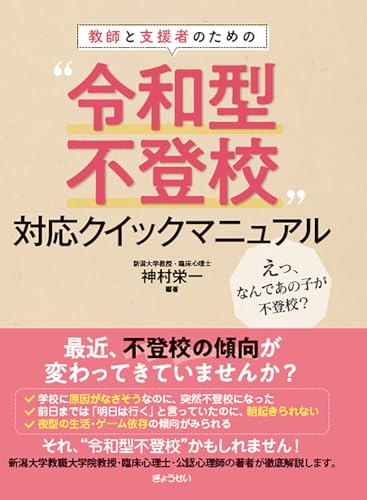
Huh? Why is that child not attending school?" -- Trends in school refusal have been changing recently.
Is the same framework for understanding and response as before sufficient?
☑ A child suddenly stops attending school, even though there doesn't seem to be any school-related cause.
☑ A child keeps saying "I'll go tomorrow" until the day before, but can't get up in the morning.
☑ A child has a tendency toward a nocturnal lifestyle and gaming addiction.
⇒That could be "Reiwa-style school refusal"! Why not take a look at effective responses in this book?
In this book:
● Learn how to deal with the increasingly common "no discernible cause" type of refusal.
● Get tips on support in an era where "taking a day off is an option."
● Support the realization of "work style reform for teachers and staff" with concrete measures that can be put into practice immediately in schools.
● The author, a psychology expert with extensive experience in schools, proposes responses tailored to "Reiwa-style school refusal."
● The checklists and worksheets introduced in the book can be downloaded from the subscriber benefits site.
●Each section is completed on two double-page spreads. Even busy teachers and staff can easily start reading from any part they like.
Recommended for:
- Teachers and staff who realize that their child's school refusal is different from previous cases, but are unsure how to respond.
- Parents who are troubled by the fact that their child has stopped attending school and can't find the cause.
Author's Message (Excerpt from the "Introduction")
Is it really okay to treat this increase in school refusal over just 10 years as "the same as before"? (Omitted)
- School refusal itself is not a sin, a disease, or an evil. Continuing to skip school or finding a place that doesn't count as school is a choice, and as long as it's not causing serious inconvenience to anyone or depriving someone of their rights, I think both the student and their family should be proud of it.
However, if this is having a significant impact, causing them to lose their normal energy, be unable to reach for the things they want to do, or feel distressed, I hope to provide a simple and specific analysis of their difficulties and support that is both time-saving and cost-effective. I hope this book will inspire you to do just that.
Table of Contents
Part 1: Situation Analysis
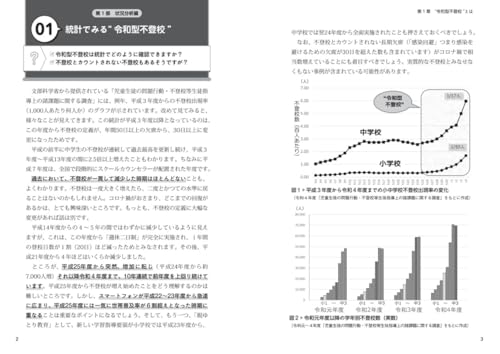
Chapter 1: What is "Reiwa-era School Refusal"?
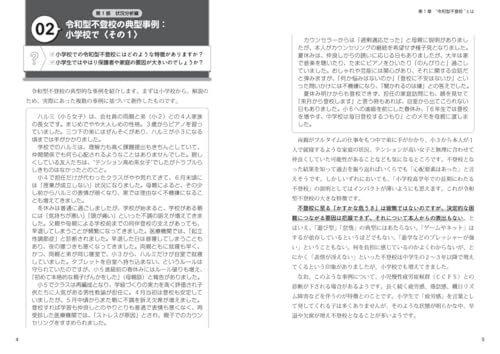
Chapter 2: Difficulties in Going to School and Living for Children in the Reiwa Era
Part 2: Prevention
Chapter 3: The Risk of School Refusal as a Warning Sign for Reiwa-era School Refusal
Chapter 4: Early Response and Prevention through Collaboration
Chapter 5: Anti-Bullying Guidance as a School Refusal Prevention Measure
Chapter 6: Recommended Sleep Habits for Families
Part 3: Case Response
Chapter 7: Are Heisei-era Support Measures Effective for Reiwa-era School Refusal?
Chapter 8: Helping Children Who Have Been Absent for a Long Time to Rejuvenate


 Rückerstattung bei Nichtlieferung

![[Audio-Download] Japanisch für die Verbindung von Menschen und Gesellschaft, Fortgeschritten](https://img.joomcdn.net/30a7fff32193b332a914c2129a02fe970d898a04_70_100.jpeg)